
How to plan an RV water budget for your next trip
Estimate fresh water and waste-tank space separately, see which runs out first, and leave room for the uncertainty of a real trip.
 By Rob Knott · · 8 min read

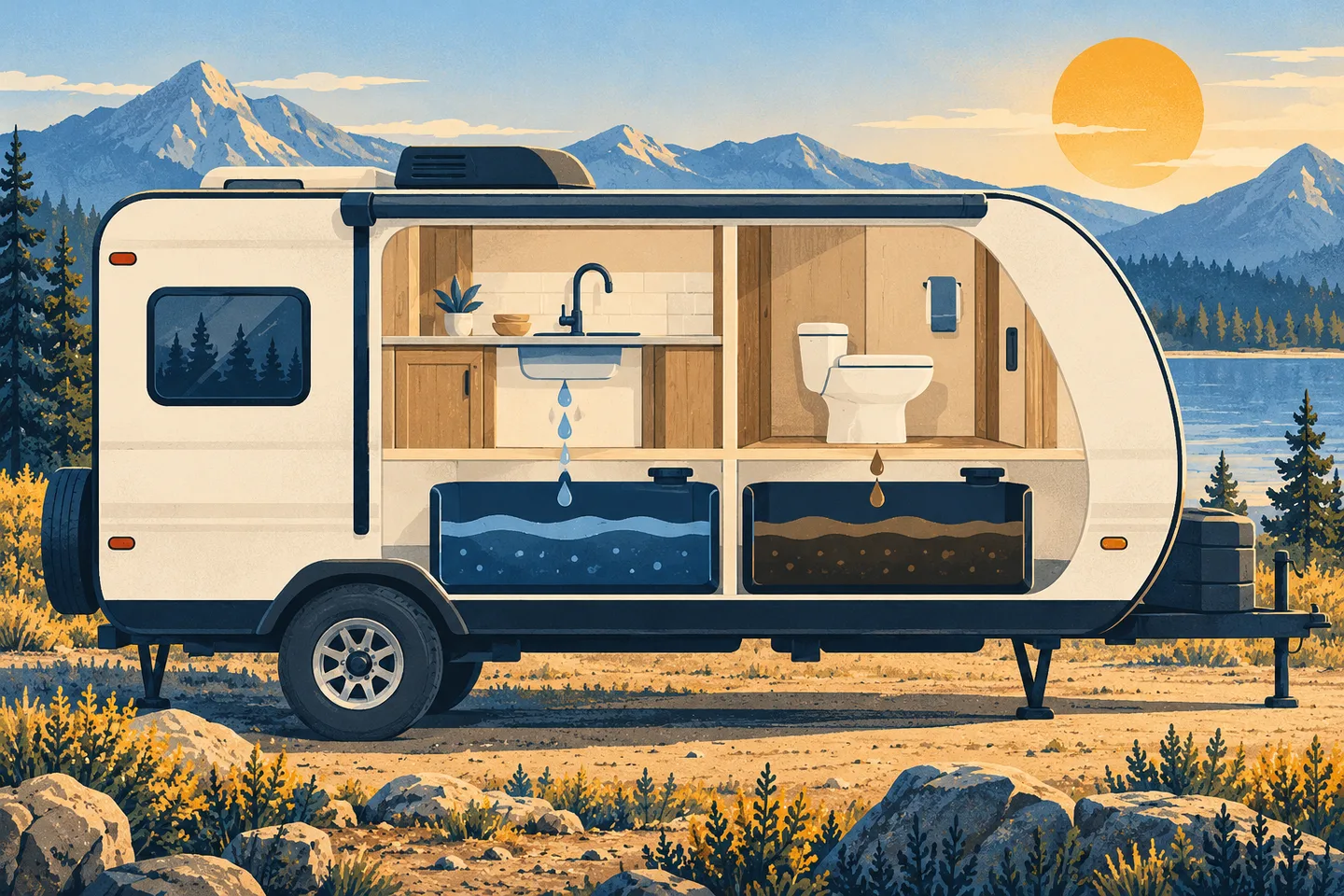
An RV water budget needs three balances: fresh water available, grey-water space remaining and black-water space remaining. Plan all three before deciding how long you can stay without services. A full fresh tank does not guarantee enough waste-tank space, especially when showers and dishes dominate your use.
Use the RV water budget calculator to try your own people, days, tank sizes and consumption assumptions. Its result is an estimate, not a promise that a particular trip is safe without a refill or dump stop. This guide shows how to choose useful inputs and interpret the limiting tank.
Start with your actual RV
Find the tank capacities for your model and model year in the owner's documentation. Do not borrow a number from another layout that looks similar. Also check whether grey and black waste have separate tanks: some small Airstream models use a combined waste tank, so a three-tank calculation will not describe every RV.
Note the current starting levels as well as the published capacity. A 30-gallon grey tank that already contains 12 gallons has 18 gallons of nominal space remaining. A 40-gallon fresh tank holding 25 gallons starts the trip with 25 gallons, regardless of the number printed in the brochure. Monitor readings can be approximate, so do not plan to use every final fraction.
Keep the capacity information with the RV documents. Write down any special system instructions too, such as multiple grey tanks or a dedicated flushing arrangement. If you cannot establish how a drain is connected, leave that uncertainty visible until you check the manual or ask the manufacturer.
List where your water goes
Make a short list of daily uses: drinking and cooking, handwashing, dishes, showers, and toilet flushing. Then decide which supplies them and which tank receives the discharge. Drinking water from a separate bottle does not reduce the onboard fresh tank; water poured from that bottle into the sink does add to grey water.
| Activity | Possible supply | Likely destination to verify |
|---|---|---|
| Drinking | Fresh tank or separate drinking supply | Not automatically a waste tank |
| Dishwashing | Fresh tank | Grey tank |
| Shower | Fresh tank | Grey tank |
| Toilet flushing | Fresh tank in many RVs | Black tank |
The table describes common arrangements, not a substitute for your plumbing diagram. The crucial habit is to account for each flow once. Do not send all fresh-water consumption to the black tank, and do not assume every gallon consumed returns to either tank. External water entering the sinks can change the balance too.
Work through an example
Here is an invented planning scenario to show the arithmetic, not a measured national usage average. Two people plan three days. They choose a total fresh-water assumption of 6 gallons per person per day, with 4 gallons per person per day entering grey water and 1 gallon entering black water. The remaining gallon per person per day covers use that is not assigned to those waste streams.
Fresh consumption is 2 × 3 × 6 = 36 gallons. Grey accumulation is 2 × 3 × 4 = 24 gallons. Black accumulation is 2 × 3 × 1 = 6 gallons. Starting with 40 gallons of fresh water, an empty 25-gallon grey tank and an empty 20-gallon black tank leaves 4 gallons fresh, 1 gallon of grey space and 14 gallons of black space after the modelled stay.
That scenario has little grey-space margin even though the black tank is mostly empty. The sensible response is to reduce the proposed stay, lower the assumptions through specific changes, or schedule a disposal stop. It is not to ignore the grey tank because the freshwater total appears to fit.
For a daily comparison, divide each usable balance by its daily rate. Forty gallons fresh divided by 12 gallons per day gives about 3.33 days; 25 gallons grey space divided by 8 gives about 3.13 days; 20 gallons black space divided by 2 gives 10 days. The smallest estimate is the limiting balance. These decimal results describe the example only.
Improve the estimate with your own observations
On a short trip with services available, record the starting levels and the day's activities. Note whether you used the campground shower, washed dishes onboard or filled drinking bottles from a separate source. The aim is to find a useful range for your routine rather than attach false precision to one gauge reading.
Time a shower's actual running water if you want to improve that assumption. Use the fixture's documented flow or a safe measurement method appropriate to your setup. Keep running time distinct from time spent in the bathroom. A long pause with the tap off has a different budget effect from a continuously running shower.
Change one assumption at a time in the calculator. First compare a day with onboard showers against one with a permitted external shower. Then adjust dishwashing or party size. This makes it clear why the result changes and which conservation step offers the most useful margin for your trip.
Conserve without skipping necessary hygiene
Conservation works best when it targets avoidable running water. Prepare dishes before turning on the tap, stop the flow when it is not needed and plan which facilities you will actually use. Airstream's conservation guidance is a useful starting point for habits, but it does not establish a universal daily allowance for all travellers.
Do not turn a water target into a reason to drink too little or ignore hygiene. Weather, activity, medical needs and the people travelling all affect requirements. This planning tool does not calculate personal hydration needs. Carry an appropriate drinking-water supply and revise the trip when the available services do not support it.
Keep water quality separate from water quantity. A tank with spare capacity still needs an appropriate potable supply and maintenance consistent with the manufacturer. A rinse hose beside a dump point cannot be treated as an RV drinking-water fill merely because it has water flowing from it.
Use the budget to schedule services
Once you have a realistic range, find refill and disposal options before the limiting tank becomes urgent. Browse our Washington directory for the current pilot and read how to check a usable dump stop. Permission, working status, arrival hours and potable refill are separate checks.
A city-water hookup also changes the model. It may supply fixtures without drawing down the fresh tank, while wastewater continues to accumulate unless you have an approved sewer connection and follow your operating instructions. An effectively unlimited incoming supply does not create unlimited holding capacity.
Before departure, record your assumptions, choose a service stop and save a backup. Recalculate when the party size, length of stay, shower routine or starting tank levels change. A useful budget gives you time to make those choices; it should never be read as a countdown to an exact guaranteed last gallon.
Sources & further reading
- Airstream: Understanding and emptying holding tanks
- Airstream Support: Tank monitoring system
- Airstream Support: Fresh tank and city water
- Airstream: Conserving water
Rob creates free, practical resources that make everyday tasks easier. He brings useful information and simple tools together so people can find what they need without unnecessary complexity.
Rob on LinkedIn ↗Put this into practice
Calculate a water budget · Prepare your dump-stop checklist · Explore covered stations
Keep exploring

How to find an RV dump station you can actually use
Check permission, service status, price and water separately before you drive. A practical way to turn a map pin into a reliable stop.
RV grey water vs black water: know your tanks before you dump
Understand what normally goes into each tank, why both need proper disposal, and how tank layout changes your planning.