
How to find an RV dump station you can actually use
Check permission, service status, price and water separately before you drive. A practical way to turn a map pin into a reliable stop.
 By Rob Knott · · 8 min read

The best RV dump stop is one that accepts your vehicle, allows your type of visit and has a working disposal point when you arrive. Start with a directory, then check the operator's current information. A map pin alone cannot tell you whether a campground accepts non-guests or whether its dump station has closed for the season.
This guide explains a repeatable checking process. Our directory begins with a Washington pilot, so it is a starting point for that state rather than a claim of complete national coverage. You can browse Washington dump stations, then use the source links on each record to confirm your stop.
Make four checks before choosing a stop
Treat permission, service status, charges and water as four separate questions. A campground can be open while its disposal point is unavailable. It can offer dumping to overnight guests while refusing outside visitors. It can provide a rinse hose without offering drinking water. Combining these facts into a single “open” badge hides the details that matter.
| Check | Question to answer | If it is unknown |
|---|---|---|
| Access | May a non-guest use the station? | Contact the operator before travelling. |
| Service | Is the actual dump point operating? | Find a backup disposal option. |
| Cost | What is the current charge and payment method? | Budget without assuming it is free. |
| Water | Is a separate potable fill available? | Plan drinking-water supply elsewhere. |
Write the answers together with the day you checked them. An old screenshot is useful for identifying a place, but it is weaker evidence for a fee or seasonal opening. If you are arriving near closing time, check the last permitted entry as well as the published closing time.
Look in several useful places
State transport agencies, park operators, campground websites and travel-stop service locators can all help. Use the source appropriate to the facility. Washington's transport agency publishes a rest-area list with distinct amenities and dump-station status. Love's service finder has an RV Dump Service filter. Those sources let you narrow a search before checking a particular stop.
Search close to your route rather than only close to your campsite. Include the correct highway direction in your notes. A rest area on the opposite carriageway can be geographically close and still require a substantial detour. This guide does not calculate routes or assess whether a particular exit suits your vehicle; use your own vehicle-aware navigation and the operator's approach instructions.
A useful search order is to identify a likely stop, open its original source, check the facts above, and save a second option. If a directory and the operator disagree, keep the disagreement visible and ask the operator. Do not turn an unconfirmed community report into permission to enter private property.
Use a short call script
A focused call is often easier than asking whether a place is “RV friendly.” Try: “I am travelling through with an RV and am not staying overnight. May I use your dump station on Tuesday afternoon? Is it working now, what does it cost, and how do I pay?” Then ask about the approach and any separate freshwater fill if you need one.
- Give the day and approximate arrival time.
- State explicitly whether you are an overnight guest.
- Ask about vehicle restrictions only if relevant to your rig.
- Ask whether there is a designated entrance or check-in step.
- Confirm whether a quoted fee includes water or only disposal.
Record the answer rather than relying on memory during a busy travel day. If nobody answers, an unknown stays unknown. A backup stop is especially valuable when the first option has limited hours, a seasonal system or restricted access.
Keep drinking water separate from rinsing water
A hose beside a sewer inlet is not evidence of a drinking-water supply. National Park Service campground design guidance describes non-potable water equipment for cleaning sewage holding tanks. That is why our directory separates potable-water information from rinse-water information.
Read the sign at the outlet and confirm its intended use. Keep your fresh-water filling equipment separate from waste-handling equipment. If the outlet is not identified as potable, do not use it to fill a drinking-water tank. A general “Drinking Water” amenity at a large rest area does not by itself prove that an RV tank-fill connection exists.
If your main reason for stopping is fresh water, make that the first question you ask. You may need a disposal stop and a different refill stop. The RV water budget calculator helps you estimate when each need is likely to arise, using your actual tank capacities and chosen usage assumptions.
Plan a backup before the tank is urgent
Do the checking while you still have spare capacity. Waiting until a waste tank is at its limit leaves fewer choices if a road closes or a facility changes its access rules. This is a planning recommendation rather than a universal tank-emptying interval; your vehicle manual and actual usage govern the operation.
Save the facility name, address or highway milepost, access answer, source link and current fee information. Save enough information to recognise the correct place if mobile coverage is poor. Add a second option farther along the route, making sure you are not treating two directions of the same rest area as interchangeable.
Our dump-stop checklist gives you a place to prepare the practical steps and notes. It does not promise route optimisation. Use it alongside your navigation, the facility's instructions and your RV's manual.
Check again when you arrive
Follow current signs and staff directions even if an older listing says something different. Stop safely before positioning over the disposal point. Check that you have the right inlet and that the equipment is intact. If the station is closed, overflowing or damaged, use your backup and tell the operator instead of attempting a workaround.
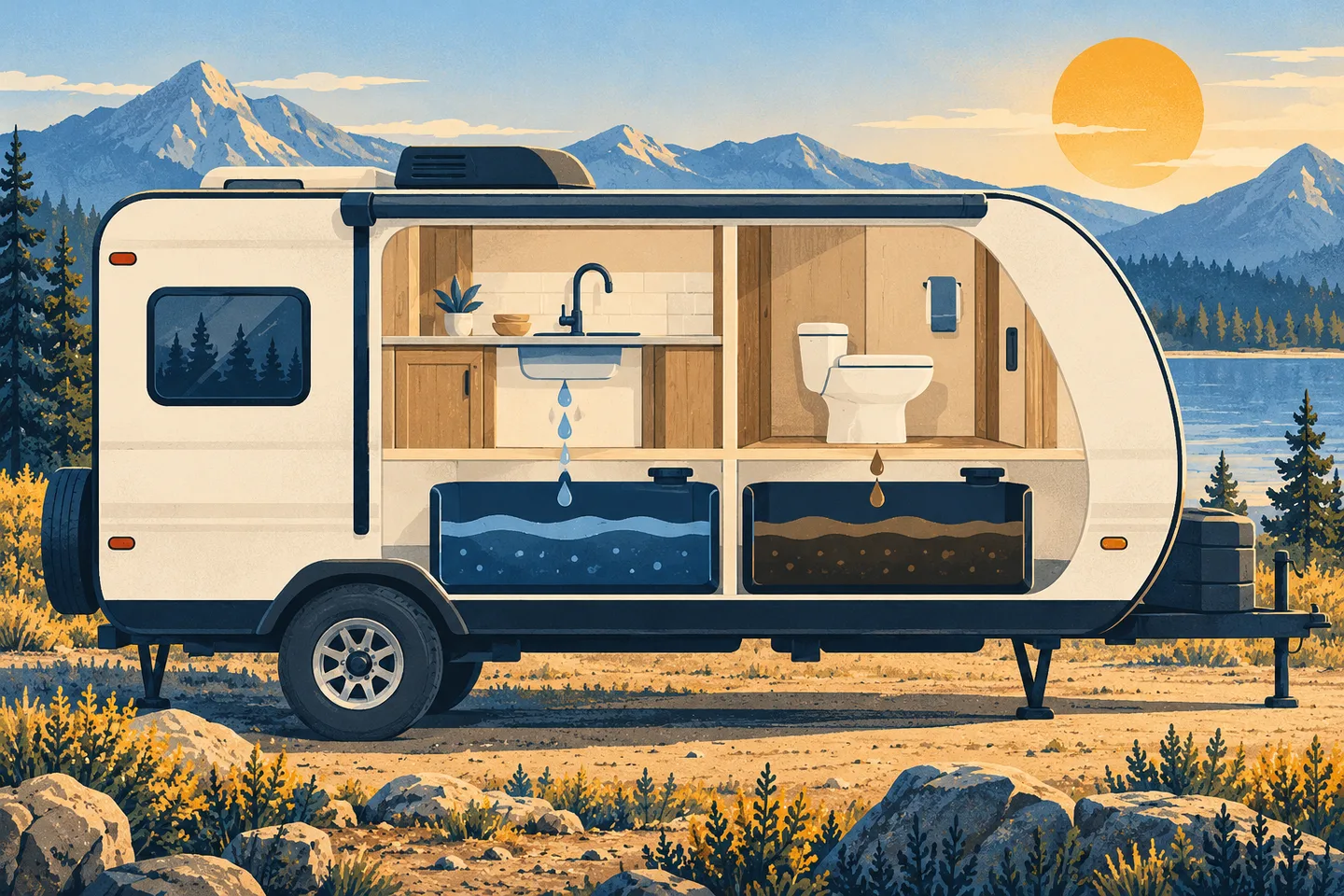
Prepare before occupying the working area, and move away when the disposal task is complete so the next driver can use it. Your model's manual should determine the actual valve and flushing procedure. Read our explanation of grey and black tanks if you are still learning which system you are handling.
A quick decision rule
Choose a stop when access, current service and arrival timing fit your trip. Treat missing price as a question to resolve and missing potable-water evidence as a separate refill problem. If the critical answers remain uncertain, keep looking while you have capacity. A little checking before the journey is more useful than a long list of unexplained pins.
Facility conditions can change after a directory check. Use the original operator links below and the sources on individual listings for current details. If you find a correction, report the exact field and the source that supports it; that helps improve the record without replacing one guess with another.
Sources & further reading
- WSDOT: Rest areas and current amenities
- Love's location and service search
- National Park Service campground design guidelines
- Winnebago: Black and gray tank owner video
Rob creates free, practical resources that make everyday tasks easier. He brings useful information and simple tools together so people can find what they need without unnecessary complexity.
Rob on LinkedIn ↗Put this into practice
Calculate a water budget · Prepare your dump-stop checklist · Explore covered stations
Keep exploring
RV grey water vs black water: know your tanks before you dump
Understand what normally goes into each tank, why both need proper disposal, and how tank layout changes your planning.
How to plan an RV water budget for your next trip
Estimate fresh water and waste-tank space separately, see which runs out first, and leave room for the uncertainty of a real trip.